
Annapurna Sanctuary
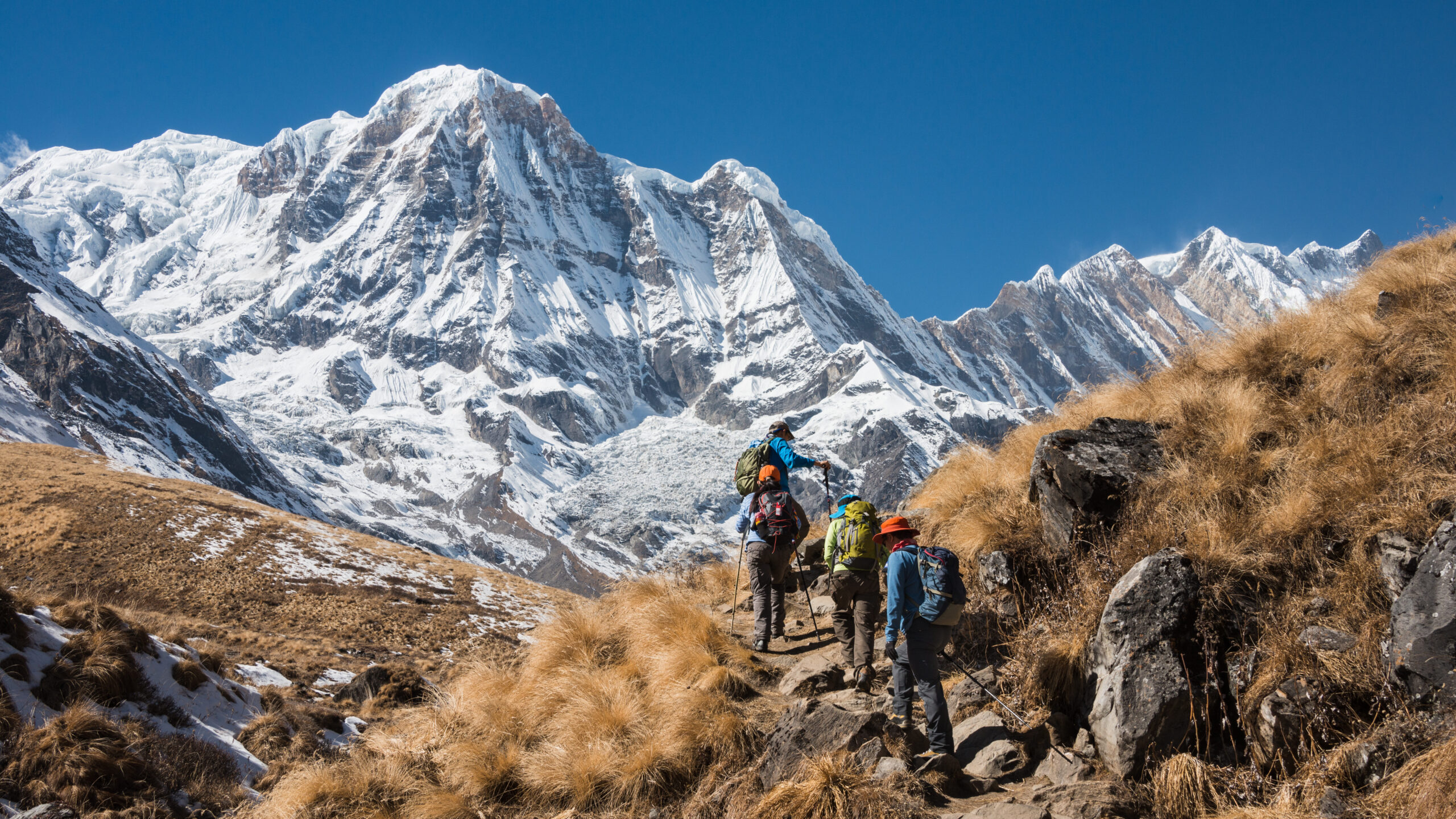
The Annapurna Sanctuary Trek leads deep into a natural amphitheater surrounded by some of Nepal’s most dramatic Himalayan peaks. The journey combines rhododendron forests, traditional villages, river valleys, Machhapuchhre Base Camp and Annapurna Base Camp, culminating beneath the immense south face of Annapurna I.
The Route
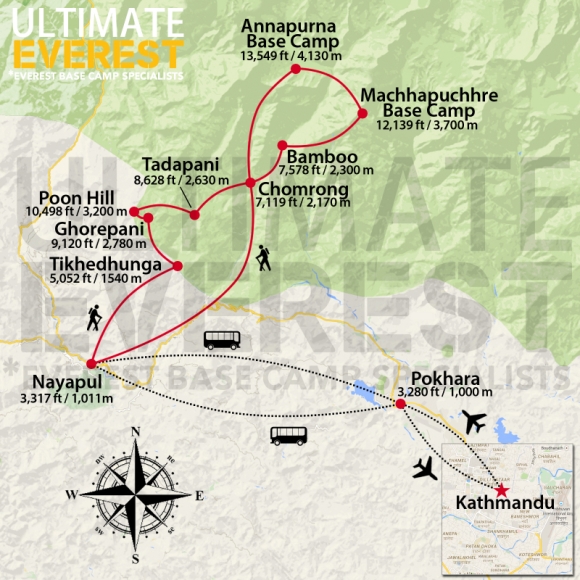
The journey begins with a flight from Kathmandu to Pokhara followed by a drive toward Nayapul. From here, the trail enters the foothills of the Annapurna region and climbs through subtropical forest and traditional villages toward Ghorepani.
An early ascent of Poon Hill provides wide views across the Annapurna and Dhaulagiri ranges before the route turns toward Tadapani and Chomrong. From Chomrong, the trail enters the narrow Modi Khola valley and continues steadily higher through Bamboo and toward Machhapuchhre Base Camp.
The final approach leads into the Annapurna Sanctuary itself, a high mountain basin enclosed by Himalayan giants including Annapurna I, Annapurna South, Hiunchuli and Machhapuchhre.
After reaching Annapurna Base Camp, the route descends through the same valley before returning toward Nayapul and Pokhara.
What Makes This Trek Special
Annapurna Sanctuary
Enter a spectacular natural amphitheater enclosed by some of the highest and most dramatic peaks of the Annapurna massif.
Annapurna Base Camp
At 4,130 m, Annapurna Base Camp sits beneath Annapurna I and is surrounded by Himalayan peaks and glaciers.
Poon Hill
An early morning ascent provides a broad sunrise panorama across the Annapurna and Dhaulagiri mountain ranges.
Day-to-Day Itinerary
Day 1: Arrival in Kathmandu
Arrive in Kathmandu and settle into your accommodation. The remainder of the day can be used to prepare equipment and get ready for the journey into the Annapurna region.
Day 2: Fly to Pokhara (3,280 ft / 1,000 m) – Drive to Nayapul (3,317 ft / 1,011 m) – Trek to Tikhedhunga (5,052 ft / 1,540 m)
A morning flight leads to Pokhara, followed by a drive toward Nayapul. The trek begins through subtropical terrain and follows the Modi Khola valley, crossing the river before continuing toward Tikhedhunga.
Day 3: Trek to Ghorepani (9,120 ft / 2,780 m)
The trail climbs steadily through villages and rhododendron forest toward Ulleri and then Ghorepani. The village sits high above the surrounding valleys and offers views toward Dhaulagiri and the Annapurna range.
Day 4: Ascend Poon Hill (10,498 ft / 3,200 m) – Trek to Tadapani (8,628 ft / 2,630 m)
An early morning climb leads to Poon Hill for sunrise views across Dhaulagiri, Nilgiri, Machhapuchhre and the Annapurna massif. After returning to the trail, continue through forest toward Tadapani.
Day 5: Trek to Chomrong (7,119 ft / 2,170 m)
The trail descends through dense rhododendron forest before climbing again toward Chomrong, a large Gurung village positioned beneath the peaks of the Annapurna Sanctuary.
Day 6: Trek to Bamboo (7,578 ft / 2,310 m)
From Chomrong, the trail descends a long stone staircase and crosses the Chomrong Khola. It then climbs through forest before continuing deeper into the narrow valley toward Bamboo.
Day 7: Trek to Machhapuchhre Base Camp (12,139 ft / 3,700 m)
As the trail climbs higher, dense forest gradually gives way to more open alpine terrain. The route passes through the upper Modi Khola valley before reaching Machhapuchhre Base Camp, surrounded by views of Hiunchuli, Annapurna South, Annapurna I and Machhapuchhre.
Day 8: Trek to Annapurna Base Camp (13,549 ft / 4,130 m)
The trail continues into the Annapurna Sanctuary across glacial and alpine terrain. Annapurna Base Camp sits beneath the immense south face of Annapurna I and offers a remarkable 360-degree mountain panorama. After time at Base Camp, begin descending back through the valley.
Day 9: Trek to Chomrong (7,119 ft / 2,170 m)
Continue descending through the Modi Khola valley, retracing the route through Bamboo and Sinuwa before returning to Chomrong.
Day 10: Trek to Nayapul (3,317 ft / 1,011 m) – Drive to Pokhara (3,280 ft / 1,000 m)
The final trekking day continues through the lower hills toward Nayapul. From the trailhead, travel by road back to Pokhara.
Day 11: Fly to Kathmandu
Fly from Pokhara to Kathmandu and spend the remainder of the day in the city.
Day 12: Depart Kathmandu
Depart Kathmandu or continue with additional travel in Nepal.
How Difficult Is This Trek?
The Annapurna Sanctuary Trek is moderately challenging. The route does not require technical climbing, but it includes repeated ascents and descents, long stone staircases and several consecutive trekking days.
The approach to Machhapuchhre Base Camp and Annapurna Base Camp also introduces significant altitude. A reasonable level of cardiovascular fitness and preparation for sustained hiking will make the journey considerably more comfortable.
Altitude & Acclimatization
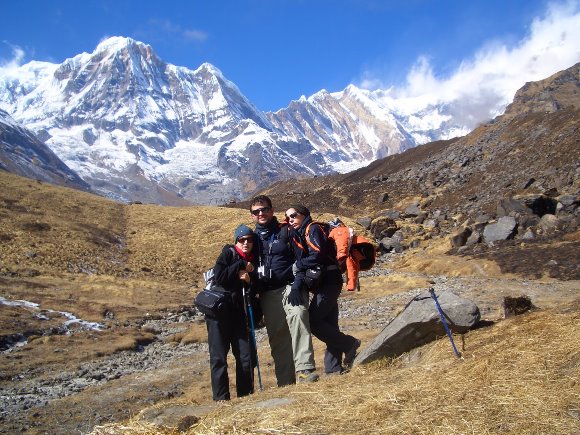
The highest point of this itinerary is Annapurna Base Camp at approximately 13,549 ft / 4,130 m. Although this is lower than the highest points reached on many Everest-region treks, altitude can still affect trekkers.
The route gains elevation progressively through Chomrong, Bamboo and Machhapuchhre Base Camp before reaching Annapurna Base Camp. Trekkers should remain attentive to how they feel as elevation increases and avoid ascending higher if symptoms of altitude illness develop.
Best Time to Trek
The main trekking seasons for the Annapurna Sanctuary are generally March through May and September through November.
Spring brings blooming rhododendron forests and generally milder temperatures, while autumn is known for comparatively stable weather and clear mountain views. Conditions become colder at higher elevations as winter approaches.
Learn more about Nepal’s trekking seasons →
Related Treks

Annapurna Circuit
A longer journey around the Annapurna massif featuring changing landscapes and the high crossing of Thorong La.

Royal Annapurna
A shorter trek through the lower Annapurna foothills, combining mountain scenery with traditional villages.

Compare All Treks
Explore Everest, Annapurna, Langtang and Manaslu trekking routes.